Hudson Labs
Case Study
Expanding Hudson Labs from single-company research to market-wide intelligence.
- Role
- Senior product designer
- Timeline
- 2026 · 3 months
- Team
- 1 founder
- 2 engineers
- 2 designers
- 1 subject matter expert
Scope
- Product strategy
- UX research
- Architecture
- Interaction design
- Prototype
Context & challenge
Hudson Labs helps financial professionals research public companies using filings, earnings calls, presentations, press releases, and financial data. Its competitive edge is trust: finance-specific retrieval, source-verifiable answers, and confidence in the numbers behind high-stakes decisions.
The main problem we’re tackling first is multi-company research. Right now, it’s hard for users to compare companies, spot patterns, generate ideas, or monitor a group of companies without getting lost or losing trust in the output.
Existing Product
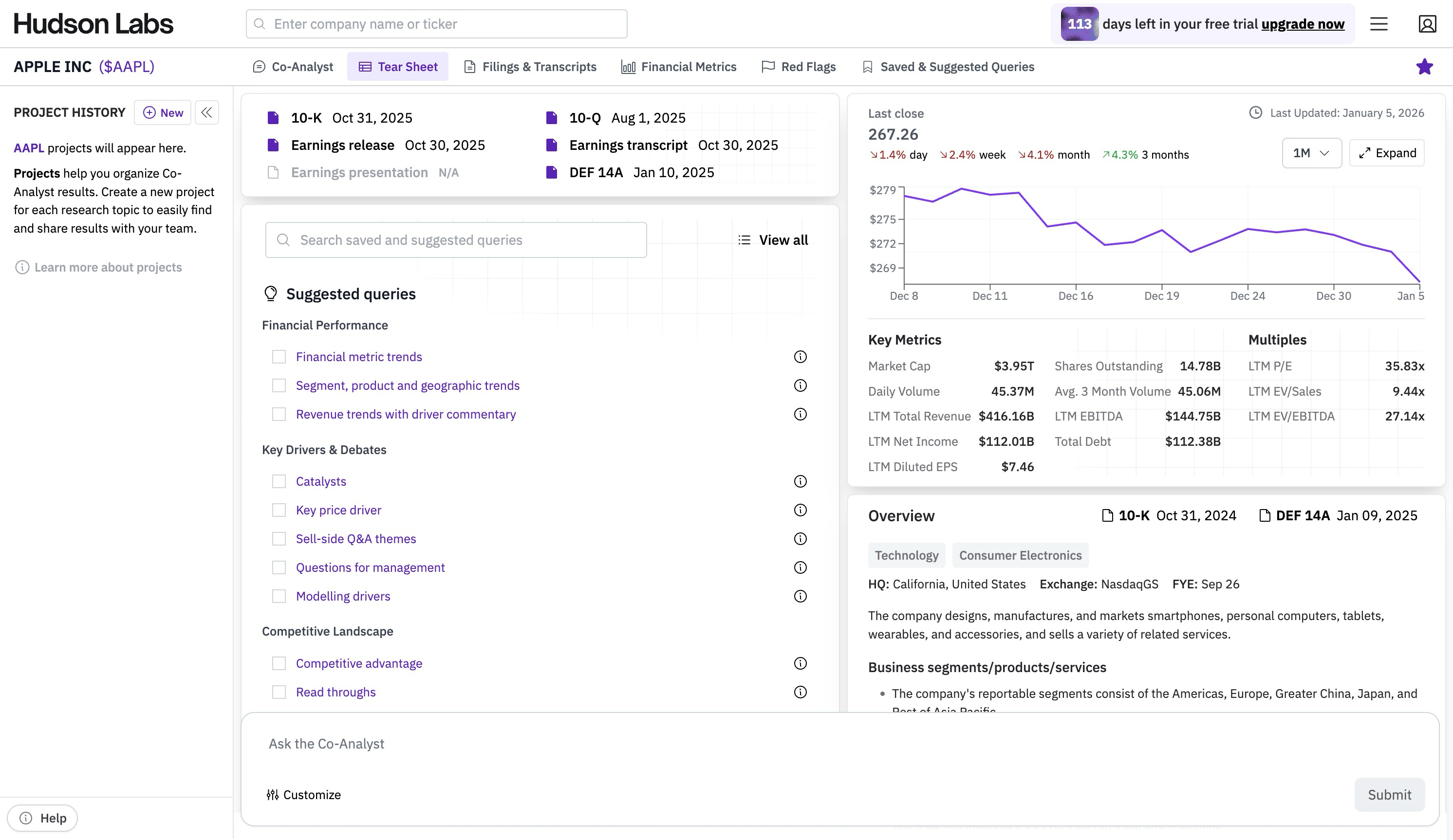
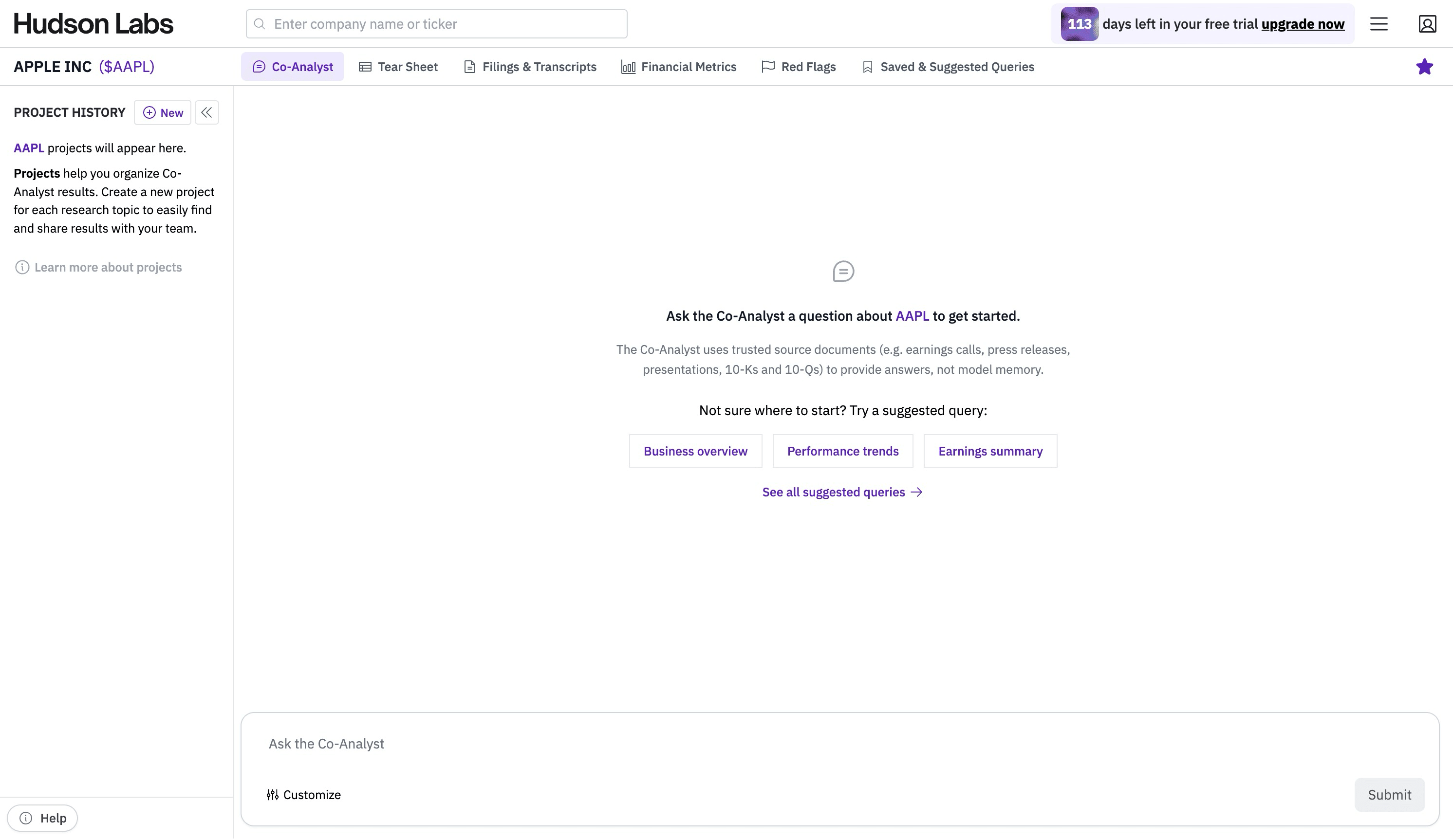
Research was organized around one company. A user could select a company, open its Tear Sheet, review filings and metrics, or ask the Co-Analyst questions about that company. It was a strong foundation for single-company research, but the product needed to support working across groups of companies.
Objective
Our role was to expand the product beyond single-company research → Help users discover a relevant universe, refine it, and research across it without losing trust or context.
Research & Discovery
We started by building a shared understanding through a facilitated workshop.
This was important because the team already had a great deal of product and domain knowledge. My role was not to arrive with an answer; it was to make that knowledge visible, identify where perspectives differed, and turn it into a shared model of the problem.
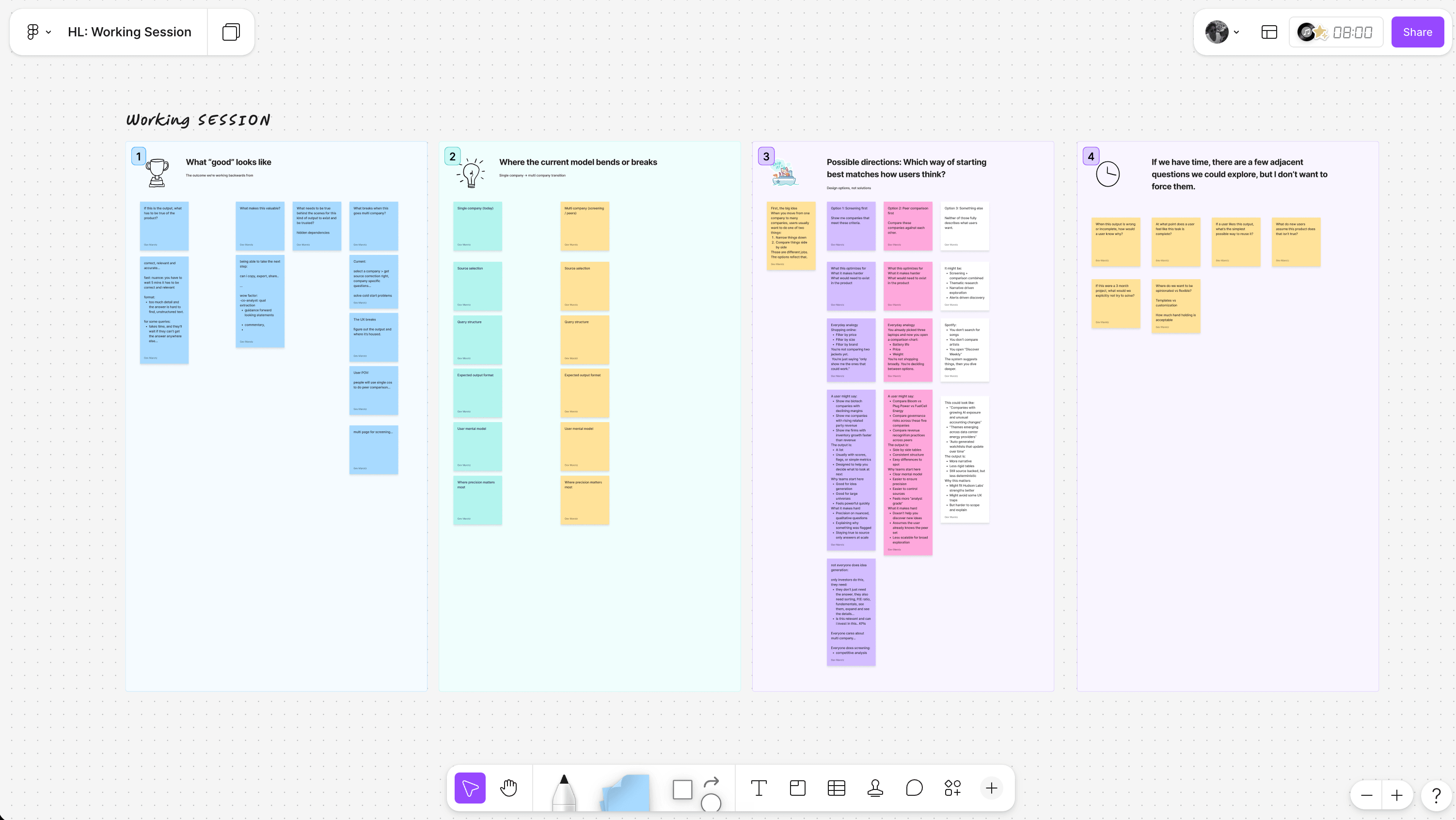
- What was working well?
- What was missing from the current experience?
- What are users trying to accomplish?
- What makes HL different?
- How the major workflows need to connect?
The workshop helped us move from a broad ambition, “support multi-company research”, to a clearer set of product needs.
Establishing Requirements
What the product needed to support
01
Discover
Define a company universe with quantitative and qualitative criteria.
02
Explain
Show why each company matched, with evidence and sources.
03
Curate
Select a useful subset and preserve it to research and/or monitor.
04
Research
Research one company or the group without losing scope.
Move without losing context
Design Principles
We established some design principles to help guide us.
Make context explicit
Users should always know what it is they’re researching.
Preserve trust at scale
Keep criteria, evidence, sources, and research scope visible.
Support progressive power
Keep screening approachable while allowing advanced criteria
Keep research accessible
Co-analyst follows the active context instead of becoming a separate destination.
Framing the work
Once we understood the broader workflow, the work branched into three related areas. Each required a different kind of investigation.
01
Understanding screening
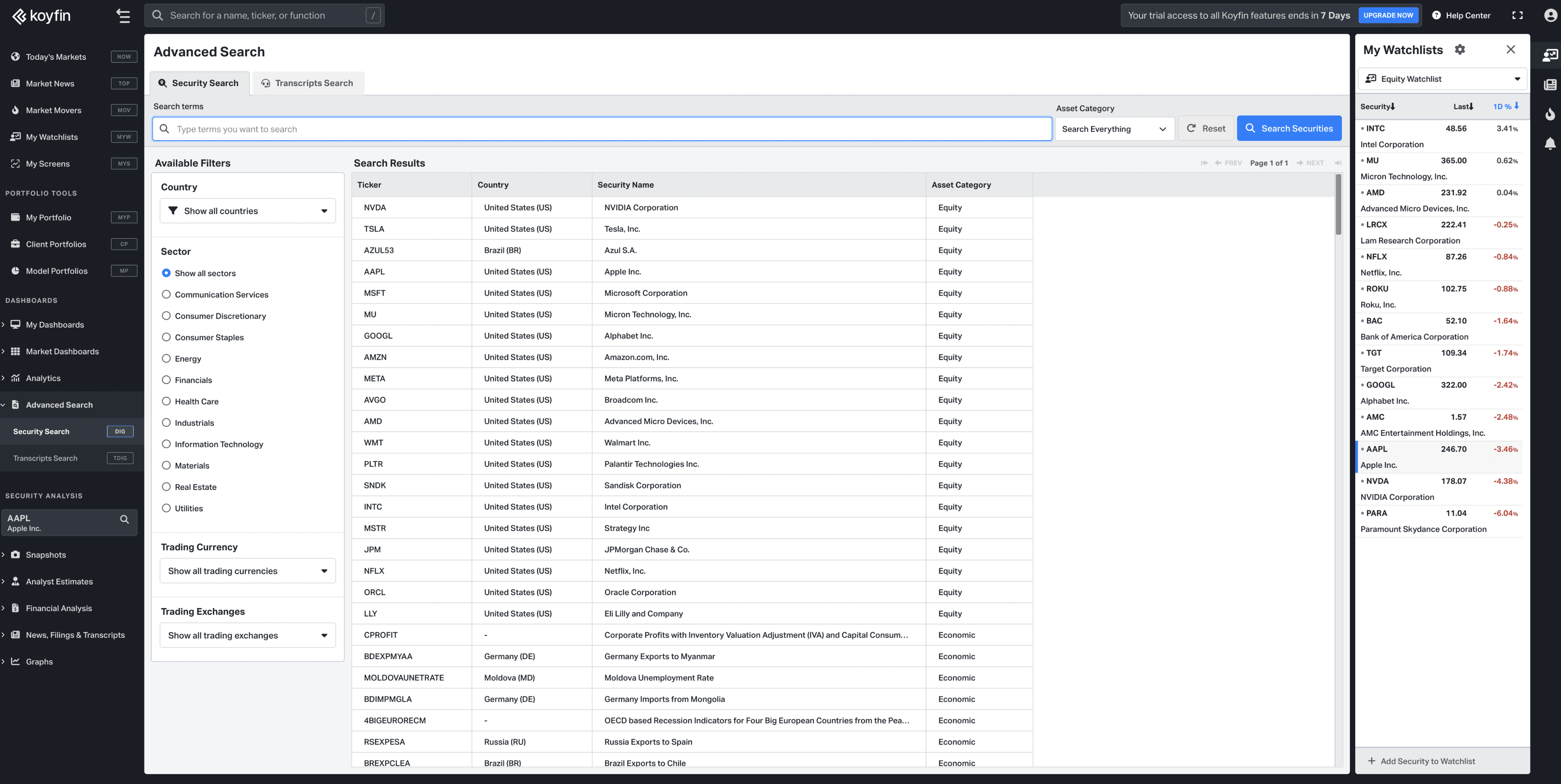
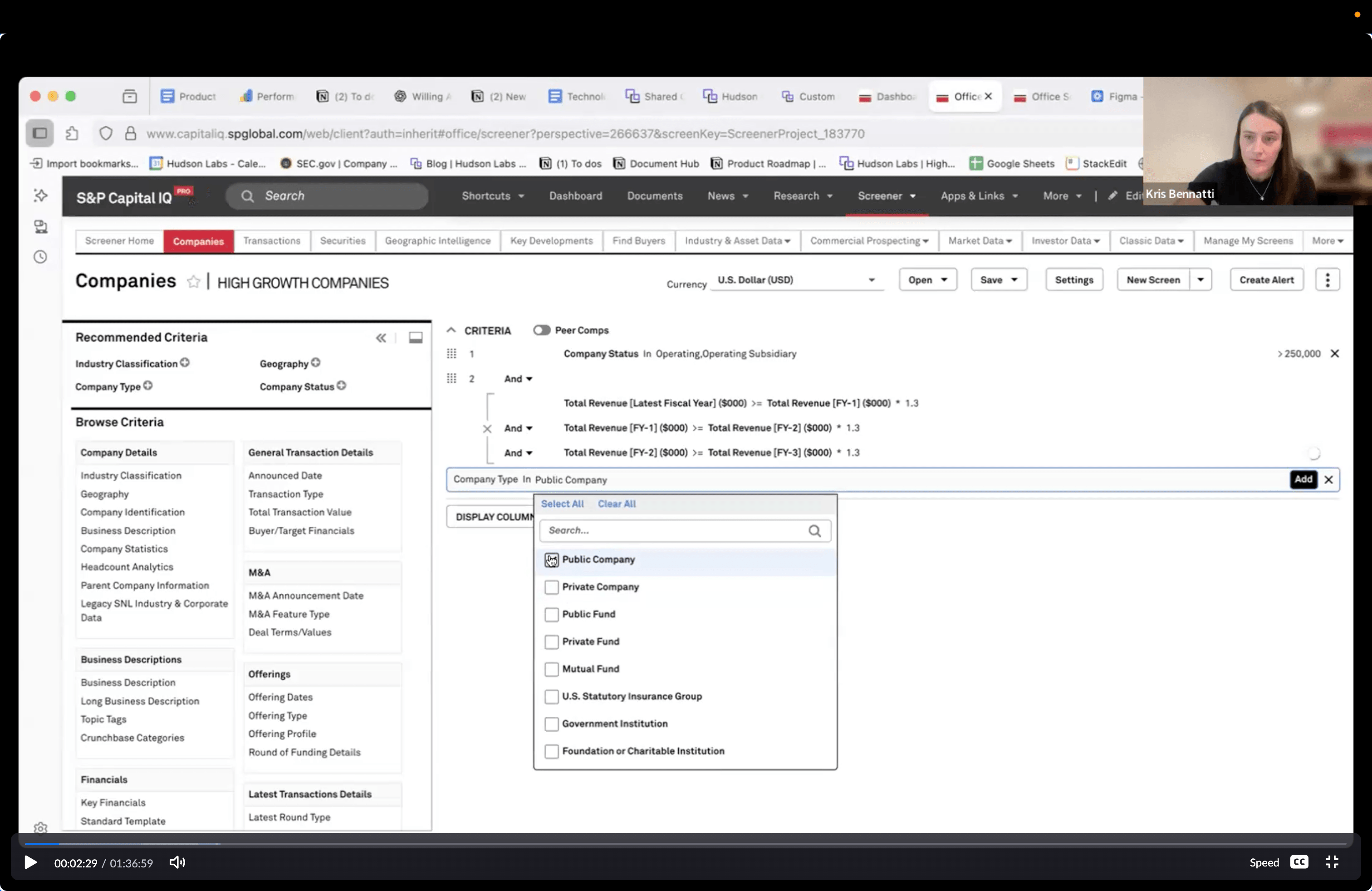
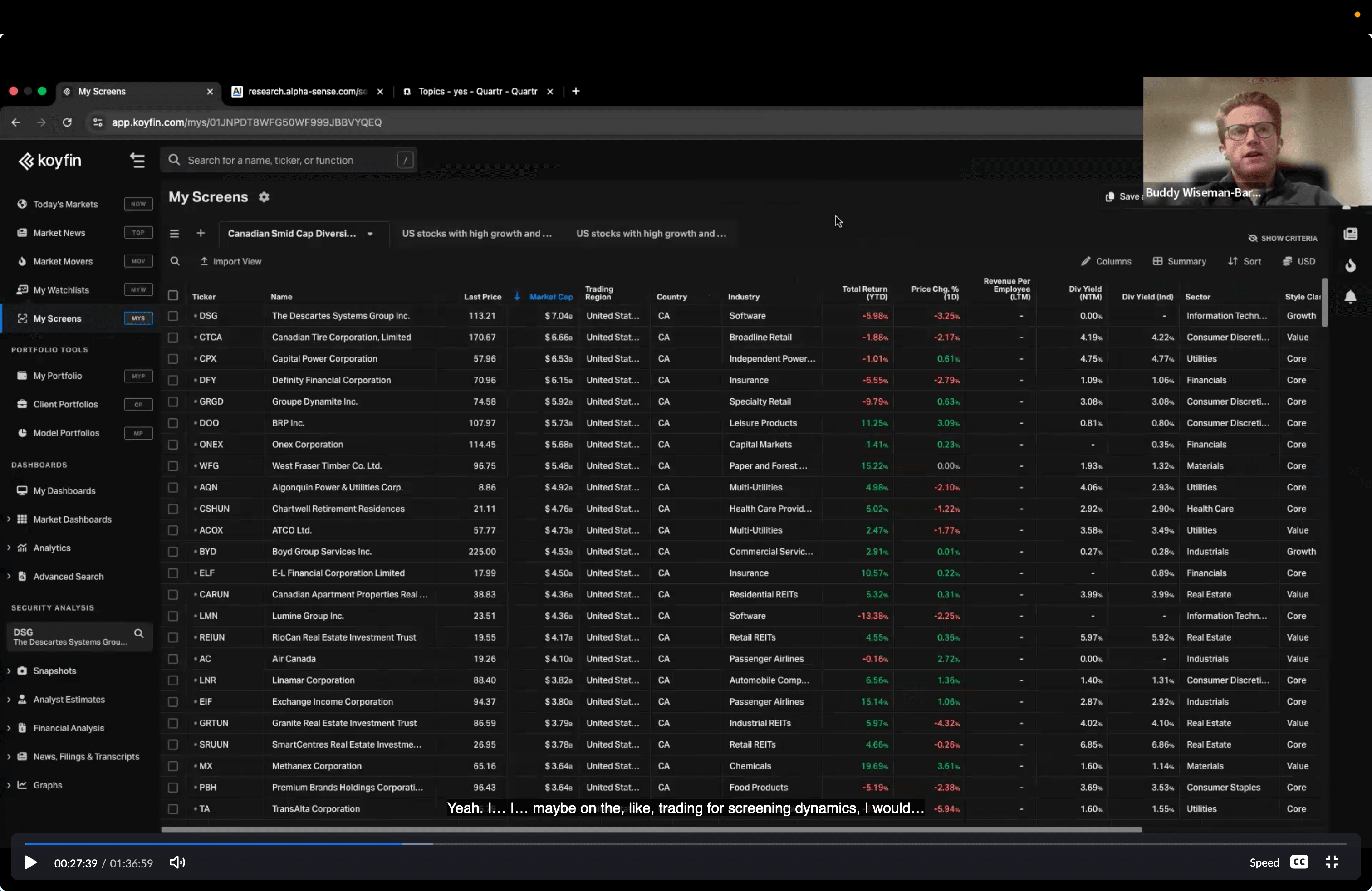
With screening, we were not starting from zero. The team walked me through leading financial products, explaining what felt useful, unnecessarily complicated, or essential for sophisticated investors.
I studied the conventions users might already expect:
- How filters were found and added
- How complex criteria were constructed
- How logical relationships were represented
- How results were evaluated
- How screens were saved and reused
The goal was not to copy another screener. It was to preserve familiar patterns while identifying where Hudson Labs could offer something different: combining structured financial data with qualitative research.
Central requirement
Quantitative and qualitative criteria needed to work together as one screening thesis.
02
Understanding multi-company research
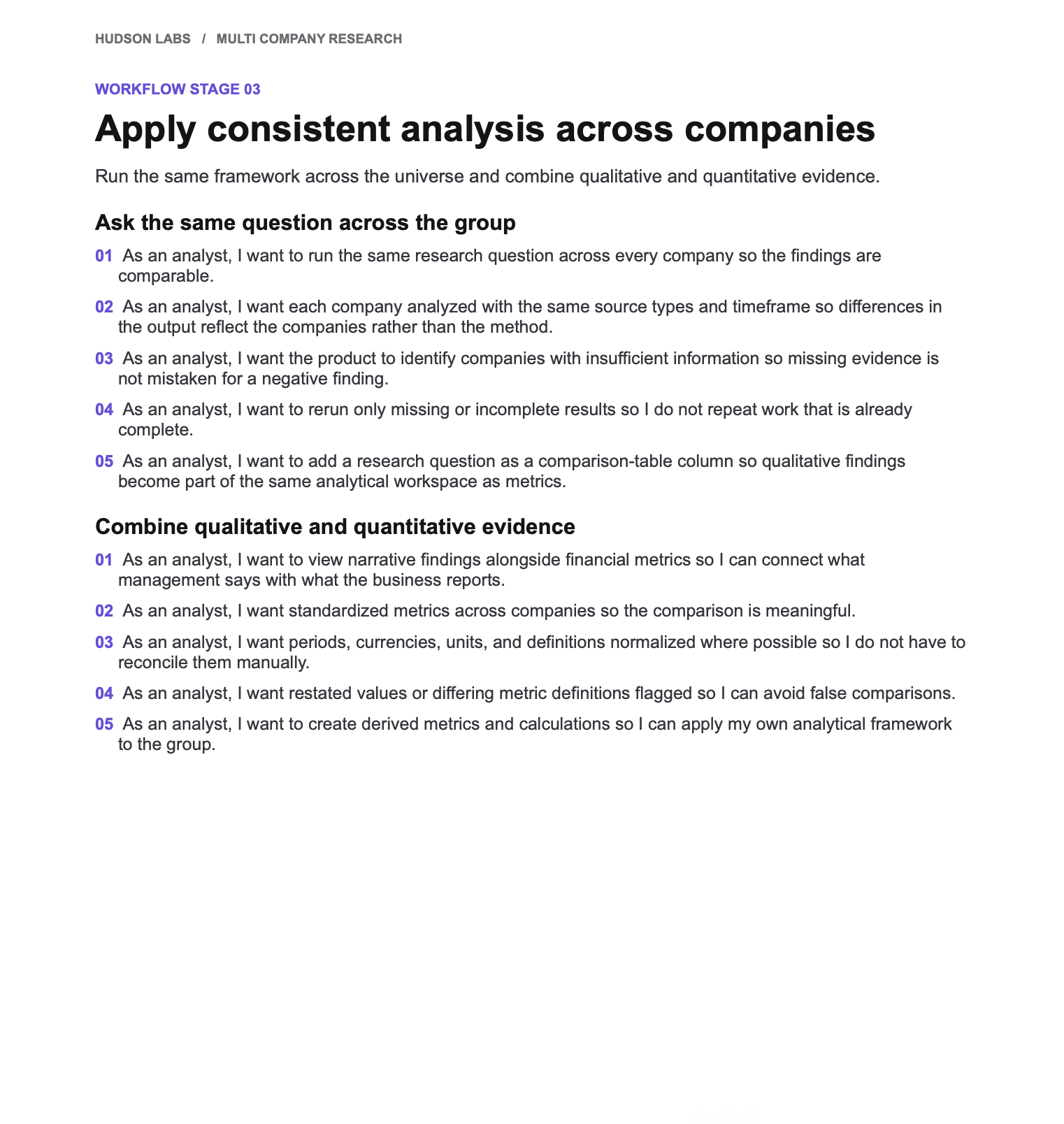
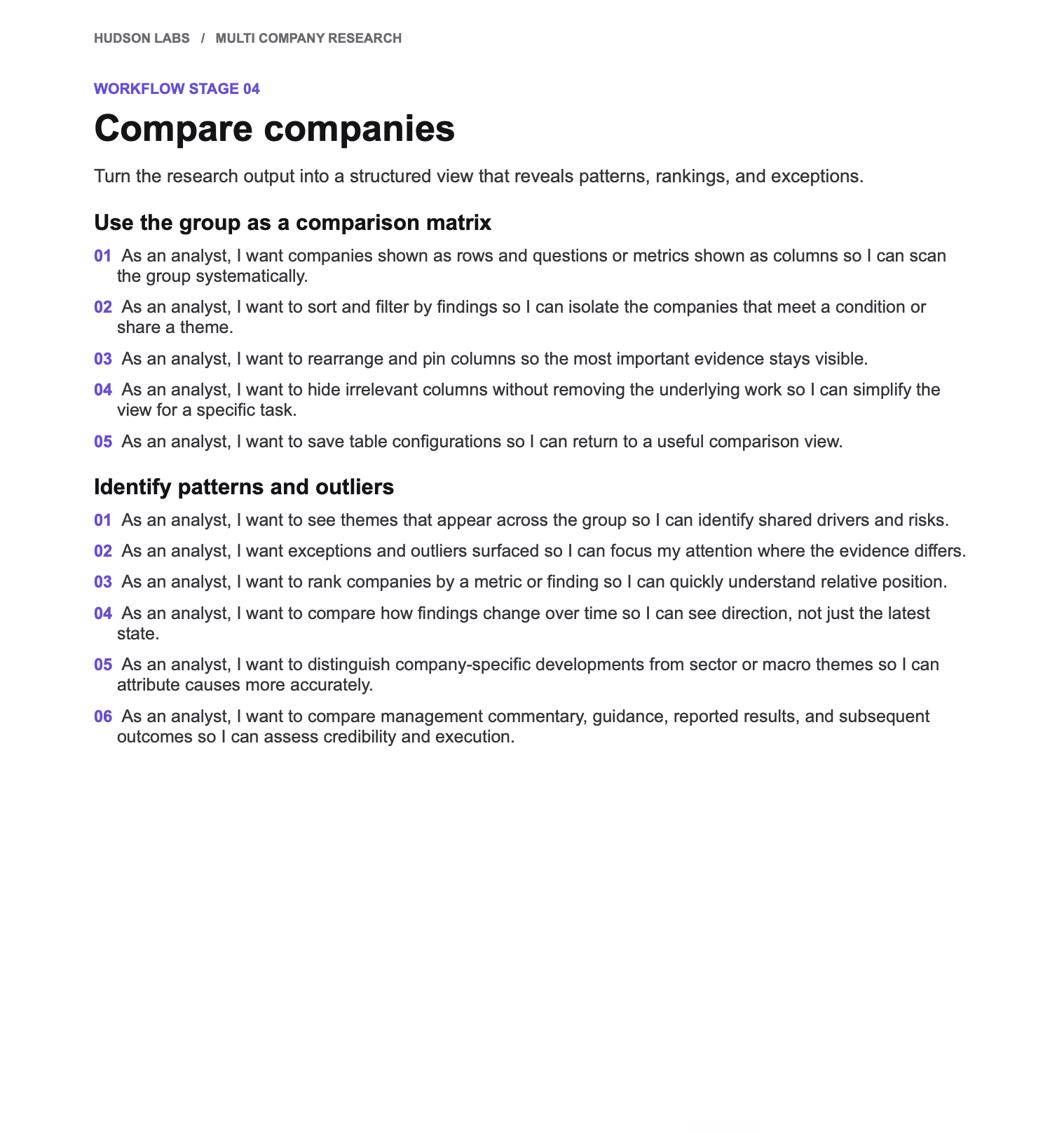
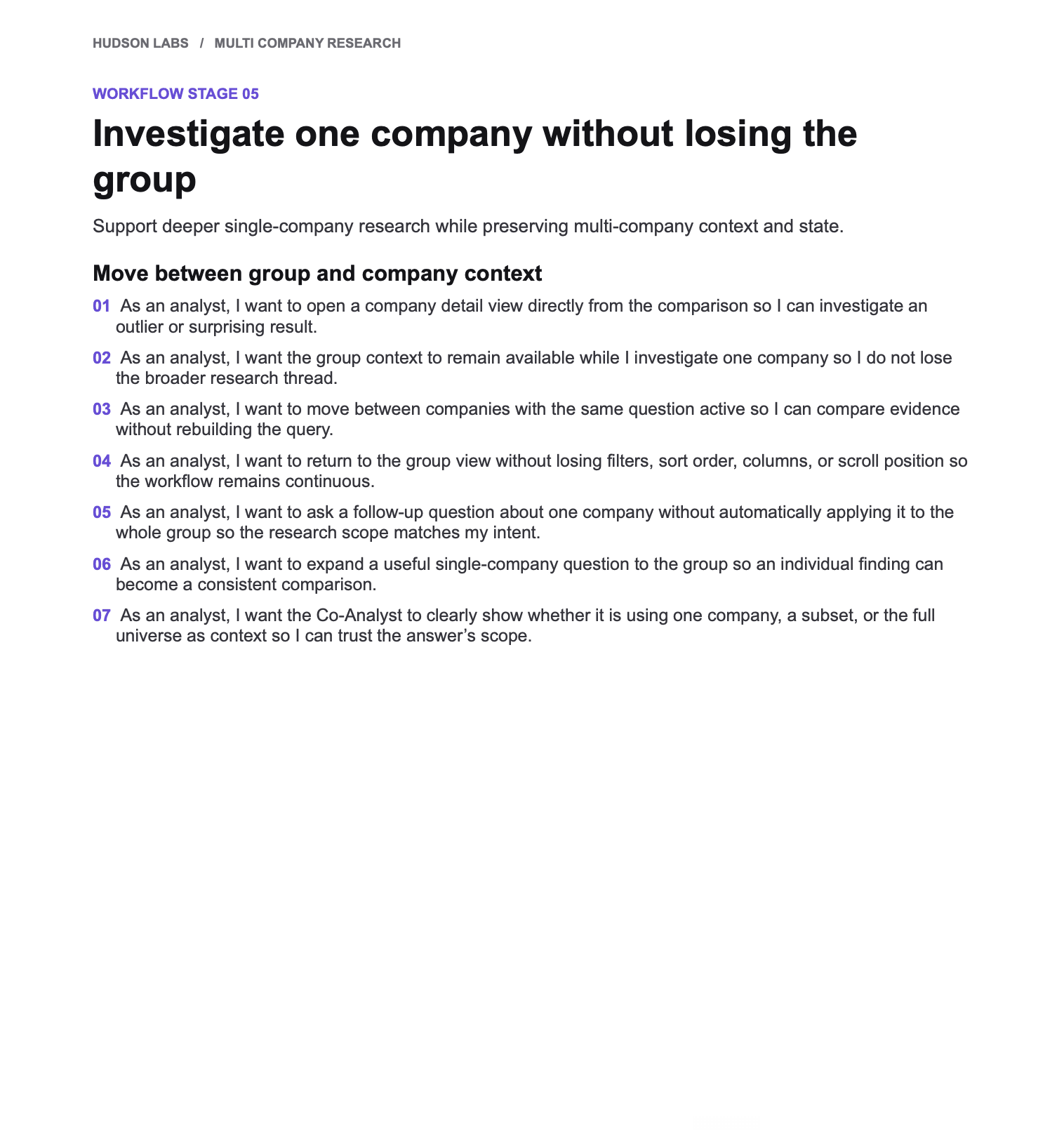
Multi-company research presented a different challenge. Before designing the interface, I needed to learn how an investor moves from a list of companies to useful analysis.
I worked closely with Buddy, a domain expert who performs this type of research professionally, to understand questions such as:
- How does an analyst decide which companies belong in the group?
- When is the goal comparison versus pattern recognition?
- What information must stay consistent across every company?
- When should the analyst move from the group back into one company?
- What should remain visible while research is being conducted?
These conversations showed that multi-company research was not simply a larger version of the single-company page.
Central requirement
Maintain an active company universe, research it consistently, compare results, and still move into an individual company when necessary.
03
Rethinking the Co-Analyst
The Co-Analyst needed to support:
- Research about one company
- Research connected to a screen
- Research across a watchlist
- Research across a selected group of companies
- and future workflows...
The third investigation connected everything else. In the existing product, Co-Analyst lived inside a single-company page. The page implicitly answered an important question: What am I researching?
Once the product introduced screens, watchlists, and company groups, that answer could no longer be assumed. This led to the most important architectural decision of the project.
Design Decision
Co-Analyst should be separated from the single-company page and become a product-level research capability.
Product Architecture
We were designing a connected research system.
By this point, the core capabilities were clear. I mapped the end-to-end flow first, then used low-fi wireframes to see how the pieces connected and expose gaps before detailed design.
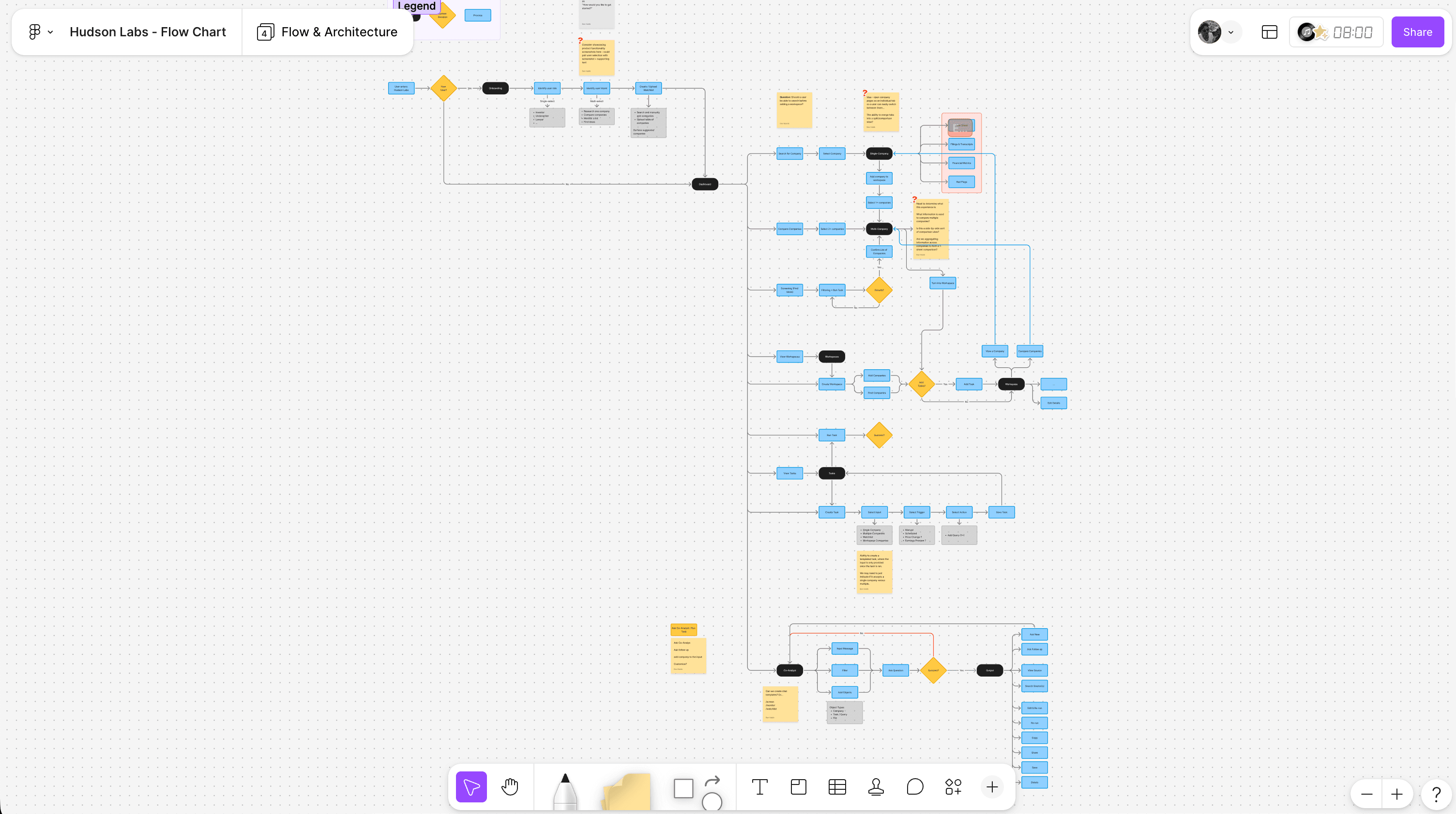
Single-company
Multi-company research flow
Screen
Watchlist
Multi-company
Co-Analyst: Shared research layer
Simplified High-Level Flow Chart
Interactive – click around
Nav
Search
Single-Company
Co-analyst
History & Suggested
{Single-Company}
Ask...
Solution
The flow from screening to multi-company research
Screening Input
Qualitative
Ask what traditional filters cannot express
Management commentary, themes, risks, language, sources, and time periods.
Quantitative
Add fundamentals and advanced logic
Market cap, sector, financial metrics, saved criteria, and grouped conditions.
Screening Output
The result needed to be more than a ticker list. Narrative evidence, financial metrics, and source documents let users evaluate matches before selecting the companies worth carrying forward.
Multi-Company Research
The same Co-Analyst could now operate against the selected company universe, supporting comparisons, pattern finding, structured analysis, and research columns while keeping the active group visible.
System Impact
The outcome was more than two new features.
The visible output included screening and multi-company research. The more important outcome was the system connecting them, and a clearer product model for future research workflows.
Co-Analyst 2.0